


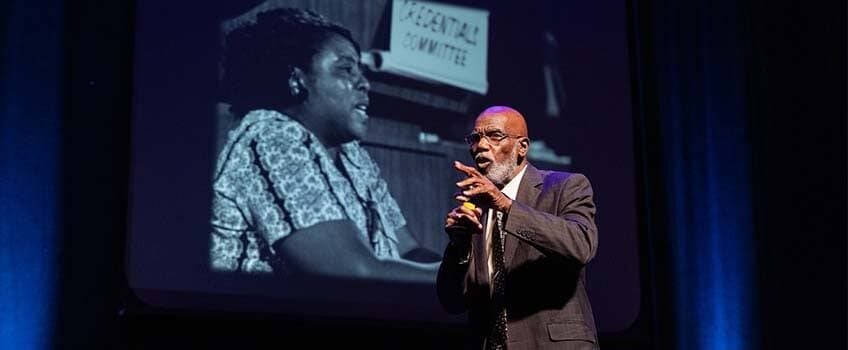
Galloway, N.J. — “It’s not about ego. It’s about we-go.”
That’s the slogan that Kenneth Salaam repeatedly came back to during his talk on Oct. 6 at the 23rd annual Fannie Lou Hamer Human and Civil Rights Symposium at Stockton University.
Salaam, also known as Freedom Smitty, is a Philadelphia-based civil rights activist who has protested alongside Hamer and Dr. Martin Luther King Jr. He urged the crowd of students in the Performing Arts Center to follow their example by confronting racism and working for change.
“The future is yours, whether you like it or not,” said the 77-year-old. “I’ve got more time behind me than I’ve got in front. I’m on my way out of here, that’s a fact, not an opinion. It’s going to be you guys. You’ve got to get up and go to work.”
The future is yours, whether you like it or not. I’ve got more time behind me than I’ve got in front. I’m on my way out of here, that’s a fact, not an opinion. It’s going to be you guys. You’ve got to get up and go to work.
Kenneth Salaam, also known as Freedom Smitty
People are also reading…
During his 30-minute talk, Salaam frequently encouraged and called on the students to respond to his words, saying they need to understand “the psychology of racism.”
“Racism is a science. It’s a subliminal, seductive science. Why does white cake equal angel food cake, while black cake is devil’s food cake,” he said. “It’s going to take each and every one of you to change that narrative.”
That call to action echoed the legacy of the woman the symposium is named after.
Hamer, a Mississippi voting rights activist, gained national attention during the 1964 Democratic National Convention in Atlantic City, where she testified before the credentials committee on behalf of the Mississippi Freedom Democratic Party. The group challenged the seating of Mississippi's all-white delegation, arguing that Black residents had systematically been denied the right to participate in the state's political process. Her televised testimony helped focus national attention on voter suppression in the South. The Voting Rights Act of 1965 was signed into law the following year.
Stockton is unique in its remembrance of Hamer as a civil rights icon, said Ian Marshall, the dean of the School of Arts and Humanities.
“I’m proud of the work here at Stockton University with faculty committed to social justice, diversity, equity and inclusion,” he said. “No other institution in all of higher education in this country consistently celebrates her like we do here.”
Junior Jayla Howard, the president of the Unified Black Students Society, said it’s important to hold events like the symposium so the work of Hamer and “many other brave Black souls are never forgotten.”
“It is so important that events like this, which are dedicated to the work of a Black woman in the 1960s, are still active, especially in times when Black people are having to continue to fight harder for basic rights and Black women are still underrepresented and dying at disproportionate rates compared to our counterparts,” she said.
The symposium is sponsored by the Africana Studies Program, Unified Black Students Society, the School of Arts and Humanities, the Office of the Provost, the Council of Black Faculty and Staff, the Office of the President, the Office of Title VI, Title VII and Title IX, and the Office of Student Development.







Welcome to the discussion.
Keep it Clean. Please avoid obscene, vulgar, lewd, racist or sexually-oriented language.
PLEASE TURN OFF YOUR CAPS LOCK.
Don't Threaten. Threats of harming another person will not be tolerated.
Be Truthful. Don't knowingly lie about anyone or anything.
Be Nice. No racism, sexism or any sort of -ism that is degrading to another person.
Be Proactive. Use the 'Report' link on each comment to let us know of abusive posts.
Share with Us. We'd love to hear eyewitness accounts, the history behind an article.