


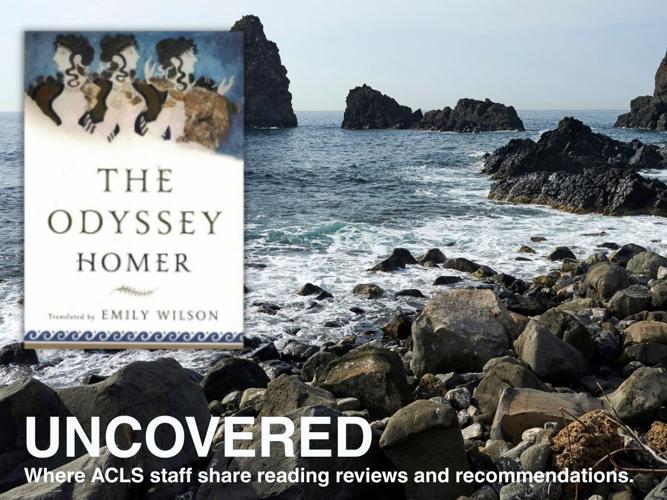
The Odyssey is among the earliest works of Western literature, an epic adventure poem that is the source of numerous canonical stories from Greek mythology. Even though two of my favorite works are comparatively modern interpretations of Homer’s tale – Charles Frazier’s Cold Mountain, which moves the action to a post-Civil War American South, and the Coen Brothers’ Depression-era comedy film O Brother, Where Art Thou? – I had never read the actual work until now. Ahead of the release of Christopher Nolan’s upcoming blockbuster adaptation this summer, I figured I might do well to familiarize myself with the real-deal source material. At the risk of sounding completely obvious (it’s lasted for millennia, so what does one “review” really mean in the scheme of things?), I was pleasantly surprised by how immediately engaging and propulsive I found the story. I do not consider myself that much of an action reader, but this ancient story was an enjoyable exception.
People are also reading…
Specifically, I read the 2018 translation of The Odyssey by Dr. Emily Wilson, a classicist currently at the University of Pennsylvania who has since gone on to translate Homer’s Iliad. Wilson discusses her approach to translating the work in a foreword, saying that her interest was in bringing the poem back to its origins as a work intended to be read aloud (another fact I had no clue about until diving into this project). As a result, the 2018 Odyssey text moves briskly and is pointedly modern at times – Odysseus is described as a “scalawag,” and while in disguise as an old man gets dismissed for “traipsing around the town, begging for chow” – a choice that I think achieves Wilson’s aim of making Homer’s work feel exciting and alive in the current moment.
Following his victory in the Trojan War (a Wikipedia tab I will admit I had to open to keep names straight at times), the Greek general Odysseus attempts to return to his native Ithaca where his steadfast wife, Penelope, and son Telemachus are waiting for him. Unfortunately, his pride and foolhardiness, along with that of his crew, have them running afoul of the god Poseidon – not a great deity to anger if you need to make a lengthy trip by sea. The story opens when our hero has already been gone long enough that Telemachus has grown into manhood without ever meeting his father, and Penelope has been enduring the sinister attentions of a horde of suitors hoping to fill Odysseus’ throne for years.
For as much of the story that I was familiar with through cultural osmosis – Cyclops, Sirens, Lotus-eaters – there was as much or more of the Homeric tale that I found fresh and surprising. Greek gods can famously never quite leave the human world to its own devices, and I appreciated the balance between the parts of Odysseus’ trial that were a result of his own poor choices and the moments where he is just a hapless pawn for a big, divine family to play around with. The moment where Zeus underlines one of Odysseus’ particularly dramatic line deliveries with a clap of thunder made me laugh aloud. In contrast, I was struck by how affecting the work is, centuries later. The scenes where Odysseus is able to temporarily access the underworld and speak with his dead family members and brothers-in-arms have lost none of their power.
Overall, I would strongly recommend the Wilson translation of The Odyssey to anyone interested in refreshing their memory on antiquity prior to the release of the film adaptation this year. It would also work as a transition for a junior high or high schooler raised on the Percy Jackson series and ready to move into more adult mythological literature. There is a great deal of contextual material included in the 2018 book, including maps, a glossary and brief explainer summaries of all 24 chapters that would be useful to anyone looking for a gateway into Ancient Greek research. For those of us only interested in a great adventure story, though, The Odyssey obviously has that in spades, too.


